Traffic Congestion and Safety on Country Roads
Worsening Conditions
Loudoun’s country roads are becoming increasingly congested and unsafe. During rush hours, traffic jams on Route 7 and Route 15 and 20-minute backups at major intersections like Route 9 and Route 287 frustrate both local residents and long- distance commuters. Frustration sometimes leads to dangerous decisions, resulting in collisions, damage and injuries.
Many of our roads are not designed for heavy traffic. Lanes are not divided because they do not meet VDOT width standards. Shoulders are narrow and thick vegetation and hilly terrain obstruct views where vehicles are moving at well over the posted speed limits.
Local Causes
A large share of the traffic volume in western Loudoun is due to interstate commuting,
connecting jobs in eastern Loudoun with affordable living conditions to our north and
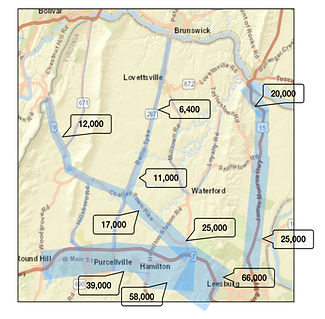
west. For the most part, this is outside the County’s control. However, as shown in this map, residential development within the County’s rural areas and small towns also makes a major contribution.
As of 2022, locally generated traffic accounted for about:
half of the volume on Route 287 at the Route 9 intersection; half of the volume on Route 9 at the Route 7 intersection; at least one-third of the volume on Route 7 as it enters Leesburg.
Average Daily Traffic Volume in 2022
Every new rural residence adds an average of 10 more vehicle trips per day to the
traffic volume. A 60-residence subdivision built in 2024-2025 along Route 287, for
example, added roughly 600 vehicle trips per day to that already congested road.
Continued development in our rural areas does two things: It increases the traffic congestion; It exposes more Loudoun residents, including our children, to frustrating and often dangerous driving conditions.
Solutions That Work and Don’t Work
Our County government, like many other jurisdictions, has for a long time operated
under the assumption that traffic congesting can be “fixed” by building bigger roads.
Dozens of rigorous scientific studies, however, prove that this is simply not true. When
roads are expanded, traffic volumes quickly increase to fill the additional lanes, both
because it encourages new development and because existing traffic re-routes to fill up what has been “opened.” We see this, for example, on Route 15 north of Leesburg, where the County is spending more than a billion dollars to add two lanes between Leesburg and Lucketts. Almost immediately after the County approved this project, developers announced plans for new subdivisions along the road that will add thousands of vehicle trips per day to the road — all of which generated within the County. Land speculators have acquired more properties that are likely to be developed in the future.
The Transportation for America website provides more detail about how “induced
demand” defeats efforts to build out of congestion challenges. If road expansion cannot solve our problem, then what can we do to keep Loudoun’s rural roads safe? First, we can continue to implement “traffic calming” measures, such as traffic circles at dangerous intersections and pullouts for enforcement, to keep traffic moving at safe speeds, minimize frustration, and prevent dangerous driving. The improvements along Route 50 east of Aldie are a good example. And, second, the County can use its zoning authority to ensure that development does not overwhelm the planned capacity of our rural road system. Private development decisions should not put current and future citizens at risk and should not force taxpayers to spend billions of dollars to build urban roads that will destroy rural areas.